热点关注
 |
卡利尔诉碳烟幕弹公司案 CARLILL v. CARBOLIC SMOKE BALL CO. |
|
论香港电影、电视剧中的律师形象及律师伦理:胡惠生先生的主题演讲 |
|
论我国承认与执行外国法院判决的法律依据 |
|
双边投资条约中的几个问题 |
|
国际经济法基本问题论纲 |
|
关于在中国法律教育中进行案例教学的思考 |
相关文章
|
国际贸易争议与仲裁(经济管理类课程教材·国际贸易系列) |
|
如愿意投稿或有什么建议或问题,请致函网站编辑部 版权所有@2005 国际经济法网 |
|
当前位置 :
首页»
学界新闻
>
杰克逊教授在与经贸大学法学院教师座谈会上的讲话 |
|||||
|
时间:2009-03-21
点击:
|
|||||
|
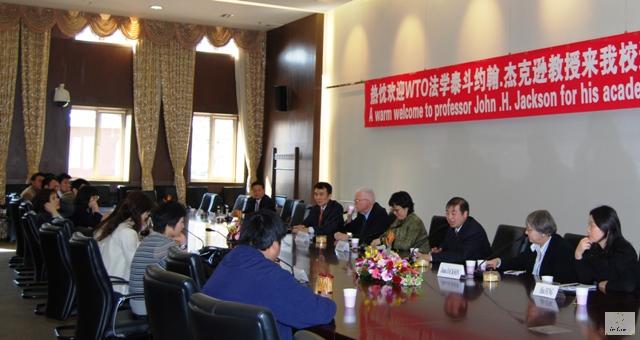
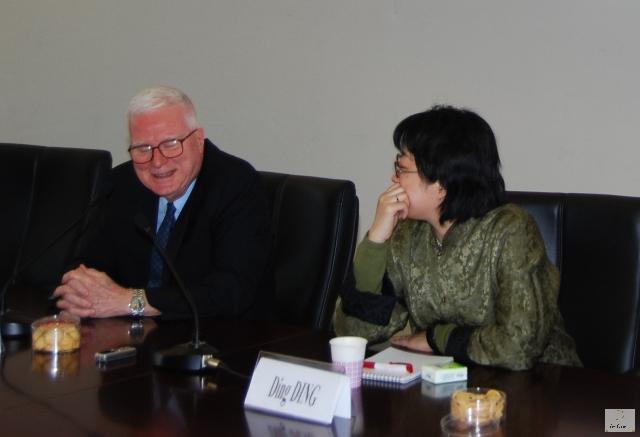
编者按:现任教于美国乔治城法学院、有“WTO之父”之称的著名教授约翰·杰克逊应对外经济贸易大学和我国商务部等单位的邀请于近期再次来我国访问和讲学。以下是他于2009年3月5日在对外经济贸易大学与法学院教师和部分学生座谈时的讲话。这次活动是他此次来华后的第一场活动。他所谈的,主要是与美国法学学术期刊相关的问题。
Thank you for this warm welcome, I’m delighted again to be here in UIBE. I have been here several times over several decades actually, and I think I have been here at least for four times, or maybe five. The first time when I was here was about 1988. That was really quite exceptional for me. I was invited here to UIBE for one week. Because at that time China was very different, over the years it has been just absolutely remarkable for me to visit again China at various times. I wish I can visit more often, but that is not possible, given the busy schedule we all have actually. I understand that today should be very informal; consequently, I didn’t bring any notes. I don’t want to make any speeches, but I want to respond mostly to your ideas and questions, but I also hope maybe later I can ask some questions of you, to learn a little about what legal education is like in UIBE, and how is it changing and so on.
Jianming Sheng has invited me to talk specifically about publication in the United States. So I’d like to do that. Let me start with the notion of what is the journal in the United States, but I will also refer a little bit to Europe and other countries. What the journals are available for publication are subjects that have international law connection. That is very board, and is broader than just international economic law. But I think maybe some of the colleagues will be publishing in other subjects and in international economic law.
Let me explain a little bit how the law journals in the United States work. Thirty years ago or longer, basically every major law school, every lead law school I should say, which certainly includes the top20 or top 50, would have a law review, a general law review for any law subjects. The law reviews were elites, and they were basically edited by a group of students. They would be selected each year from the classes that were about to become the senior or third year classes in American legal system. As you know, American law schools are 3-year programs after undergraduate subjects, and you have to have a college degree to enter American law schools. American law schools are three years, so the third year is the senior year. There is a selection process in each of these schools for the law review editorial board. And that selection process would come at the end of their second year. The very top students will be selected on the editorial board of the law review. So the law review has become fixed deeply as an important institution in American legal education. The student editors gain enormous valuable experiences, and I had that experience many decades ago. I can remember very well. And I treasure that experience because it requires the students really to develop and write an article, and to edit another student’s article, more junior students’ articles, and to prepare the issue for the journal. Most of the journals were eight issues a year or four in some cases accordingly. Among law schools in America, the law reviews did vary a lot, so it’s a little hard to generalize, but in top elite schools like Harvard, Yale, Michigan, Columbia, NYU and Virginia, those law reviews were more or less considered as elite ones. Quite often the students ran it because they were elite, very selected and very top in their classes. They also searched the privilege and searched the directions of the law review. Now usually there was and is every year actually faculty sponsor and faculty guider for the law review, but quite often the faculty member dose not really intervene much. It’s really up to the law students. It’s really an advanced student ran process. That offered a very good addition to the legal education of students in those schools. That was valuable. #p#分页标题#e#
Now, time went on. There began to develop an alternative law review in the same schools, that’s another law review, not just general law review, but a law review on specialized subjects. Those specialized subjects could be almost many different things, for instance, it could be a special journal on family law or a special journal on securities law, etc.. But quite often with the development over the last two to three decades, many of these law faculties have developed a journal on international law. So we have the Michigan Journal on International Law, the Columbia Journal on International Law, the Harvard Journal on International Law, etc. . Those became the second or sometimes the third law review in the context of law reviews in the United States. Now just from the footnote, in less than a decade and a half actually, there’s subsequently been added even a number of more law reviews. Now we have in Georgetown ten law reviews, in ten different subjects. And the same is in Harvard, Yale, Michigan and so on. So we have lots of law reviews. That partly represents different interests, different focuses and different subject matters of these different law reviews. But it also develops as a way to broaden the number of students who would have experiences in law review writing and law review editorship. In other words, it becomes today much more common for students to have law review experiences. You know five to ten times more common for students to have law review experiences than it was thirty years ago. So that’s the overall setting I want to paint, just to give you an idea of the approach of the legal education in the US.
Now I want to focus a little more on the international law reviews, which I think are the law reviews that might interest you most. I can’t remember the exact number, but I think the number of international law reviews of law schools that are student ran is in the order of 60 to 80. There are 60 to 80 law reviews have to do with international subjects. Now some of these focus on particular subjects of international law, such as human rights or other things, or international economic law. But most of generic international law reviews will publish subjects on international economic law, international human rights law, international law generally, international law theory, philosophy… the whole row. So this, in a sense, offers a lot of opportunities for publication. Now I should add that the history of law reviews is that there will be some articles that are by students- usually short articles by students. But usually the majority of pages in the law review will be articles submitted by advanced scholars of various kinds, advanced practitioners, etc.. These are submitted to each of the law review. And generally the question whether they are accepted is up to that student body-student editorial group. So you will find virtually each of the law reviews has its so-called article editor, a student. And his/her task is to look at every article that is submitted from the outside-non-student articles now, and decide which article should go into their journal. That’s a lot of opportunity to publish. #p#分页标题#e#
Sometimes it is a difficult question: where to publish? Obviously some of the law reviews have a much higher prestige. I have mentioned Harvard, Yale, Michigan, Virginia, Columbia, NYU, certainly a few others also are in the picture to some extent, such as Minnesota and California University etc.. Indeed some of those schools might tend to be trained to talk on certain subject matters, so in a given year the editors might be more interested in human rights law, in another year they be more interested in other subjects. So it’s a little hard to tell which direction you’re going. What happens?
First of all, I have to add that a couple of journals that are not student ran. I have to talk about those. There are two that I know best, because I have been on the editorial board of both of those among the editorial board of about 60 journals I think. These two are really active ones. One of those is the American Journal on International Law. And that is sponsored by the American society of International Law. And the other for which I’m the chief editor is the American Journal on International Economic Law. And the American Journal on International Economic Law is independent of any sponsorship. It is not sponsored by a law school or other institutions like a society. It is independent, but it is published by Oxford Press in England. Both of these journals are what we call period-reviewed. The student journals are not period-reviewed. The students have full say what’s going to happen. The period-reviewed journal, like the American Journal on International Law and the American Journal on International Economic Law and a few other journals, have period-review process.
And let me explain how it works. That means that an article is submitted to the journal, and there will be someone-an editor, not a student editor, there will be a professional editor. For instance, the American Journal on International Law has usually in the last decade and a half or two decades coeditor or two editors, there are two editors coediting the journal, and then there is an editorial board. In the American Journal on International Law there is a editorial board having about thirty professionals, either full professors or very senior professors throughout the world, and a few are from foreign countries, most from the United States as you can imagine. They are on the editorial board. But say it that articles are submitted to the American Journal on International Law. First of all the two coeditors will decide a first cut, they will decide whether the article will go on for the period-review or not. If it doesn’t go on for period-review, then it is rejected. Now, one has to understand the rejection can be based on four or five reasons. One is that it is not well done in terms of language; another is that it may not be well researched; the other reasons include the fact that maybe that journal has already published some subjects that are submitted again, and the journal dose feel it is not worthwhile to publish again some subjects they have published already. Or maybe in a particular issue of the journal there are really many good articles. They have to decline and have to reject some articles that are perfectly worthwhile in another journal and can go to another journal and get published. #p#分页标题#e#
That is the process, what happens if it is accepted in the first stage-accepted to send to period-review? I’m talking about the American Journal for a few minutes and then I’ll come back to talk the journal I edit. I have been on the American Journal editorial board for three decades or so. I meet the stage they call me honorary member, which means that I’m not allowed to vote any more, but I’m still a member of that editorial board. So I know the editorial board and the editorial members quite well. Well, the two coeditors say:”this is a pretty good article we just receive from professors.” Now we will send it out for period-review, then they will select usually two or sometimes three members of the editorial board, to which they will send the journal manual script and ask them for their comment on whether the article is appropriate for publication in the journal, and how well they think it is. And they usually ask the editors to do one of three things. Firstly, they can reject, I should say, they can recommend to reject, because the chief editor will decide, but the period-review can recommend to reject. Secondly, or it can recommend to accept. Thirdly, it can recommend publication after modifications, after improvements. The period review from the editorial board members, two or three, is anonymous. Those period-reviews go back to the chief editor and they are reviewed to the authors, but it is never told to the authors what the reviewers’ names are. So it’s an anonymous review. That is the period-review process.
The American Journal on International Law gets hundreds manual script as you can imagine. It is the largest international law journal in the world, partly because, as part of the American Society of International Law, anyone belongs to the Society, and there are four thousand members, automatically gets a free subscription to the journal. So that’s a very large subscription rate for any law journals. That means the American Journal on International Law really has a predominant position or overall position in generic international law subjects, subjects such as human rights, international economic law, trade, WTO, etc.. There are articles of everything. But the upside of the American Journal on International Law is that they prepare to publish some longer journal articles than most journals would. But the downside of the American Journal on International Law is that they publish fewer, it is quite often the American Journal on International Law will have only two these articles, because the American journal also has about ten specific parts: the book review section and the current case section and so on. Have the journal devoted to other things and articles, it means it doesn’t have the space for too many articles. That is understandable. It is therefore reasonably difficult to get acceptance, but it is still an ideal place to publish, in the sense it’s richness in audience, much bigger the most journals. #p#分页标题#e#
The American Journal on International Economic Law is a little bit different. First of all, it’s a subset of the whole international law subject obviously, basically international economic law. A group of us started this journal about 12 years ago, have made it into a contract with the Oxford Press to publish it. We negotiate that contract, so we have got broad freedom of how we select articles and what articles we select. We have control over the editorial board, an editorial board of 40 persons. You can see the list on the web at any time. In addition to the editorial board, we also have an editorial advisory board. This is a group of very eminent persons, and the number is between 15 and 20, who we do not call on to edit, or to do period-reviews unless they are willing to. But we hope they could improve us, and give us advice from time to time. So we go about our business in the journal I mentioned with a group of starters, and I think it was about 15 top professors who started the journal and we started 12-13 years ago. It works out as we think quite well. We added to the editorial board younger people in the last couple of years and we are doing some more of that. And we follow very much the period-review process of the American Journal on International Law. So we receive articles. The Oxford Press pays for a half-time research editorial assistant to me. And I have that person comes to Georgetown. And usually that’s someone working on thesis, papers and so on. Quite often it’s a student from Europe, Latin American, or elsewhere. So they will spend their half time on working as my editorial assistant, and half time working on their thesis or other projects. That works very well. That person receives all the documents and all the submittals. And it is he or she and more often a she than he that I’m going to meet weekly, and we go over the manual script that comes in; and we decide whether it should be rejected right away, or sent out for period-review, and then make decisions later.
Let me talk a little bit about what we expect in those manual scripts, because it might be crucial to what somebody of you is thinking. But remember all along apart from the two period-review journal I mentioned, there are 60-80 other journals where you can get published. Don’t always shoot for these two. And also you can imagine these two journals turn down a lot of articles as they have to. I don’t know the American Journal on International Law turn down what, but in our journal the number of manual scripts that get approved through the whole process is something about one out of four, or one out of five.
Now, what we do when we look at an article? The first thing we do is to look at the writing. And here immediately you might see a problem from your point of view, because if you are writing in English, for instance, for this journal, you have to worry about your English being real English, because we do get a certain number of articles that are reasonably from English countries but are not good English. And we do not have time to go through this kind of articles, so we just have to reject, and hope the person find another way to handle it.#p#分页标题#e#
Now, let me talk a few minute about this linguistic problem. When we are reading for approval an article in English from a foreign, non-English mother-tongue person, we can detect small problems and big problems. The small problems are little problems of the grammar, and the way words are handled, and mistyped almost and so on. If we see a lot of those, we feel we have to reject, and we don’t have time to go through and make those correction. But even if the English seems pretty good, there is still a problem in some of these manual scripts of the reader being able to understand what’s going on in that article. That sometimes has to do with the structure or the organization of the article. Because that if the structure or organization is kind of loose or rambling, it is very hard for the reader to see where the author is trying to go. It is also the case, sometimes the language seems correct, but it doesn’t seem to have a meaning. So one of the things I suggest to the some writers who submit or otherwise discuss with the writing work is that if it appears that you have some problems transmitting your ideas in English, you need to find somebody whose mother-tongue is English to go over for you together. And we certainly encourage that, because it really dose improve the quality and increase the chances of acceptance as well.
Having said that it is not just the cause of English we are looking for, we are also looking for the articles that are sound scholarship and not too long. You look at the inside cover of the American Journal on International Economic Law, we suggest a goal for authors to keep their works something about 20 to 30 pages and not more. We have gone longer in certain cases, but we first of all look at the length of the articles, because we have a lot of articles and we want to have really more published. But also one of the things we discover is that quite often a long article is not that well put together in a sense that the author’s been a little bit too easy of duplicating, and that the logic is repeated in various parts. Several times we send back the article to the author and saying “look, we think you could cut out section three of this entirely”, because it duplicates or is irrelevant, or something else. And sometimes the authors are able to shorten their work, and make it become more acceptable. So those are things to have in mind. These are some of the things we have to struggle with.
And also when we look at an article, we want to know whether the article is making a contribution. And there are several dimensions of that. First of all, we want the article to be more than just a presentation of facts, more than just an explanation of factual material. We want the articles generally to have some kind of a fresh proposition that they are trying to put forward and which can be carried out by policy makers, or is presenting some kind of theory, or maybe is an article reacts to a previous article by saying we disagree with what the previous author has said, or various things like something more than presenting facts. In addition, we want to see the article is aware of, and has taken account of the recent literature. That is that if we know of some other articles on the same subject the author has ignored or hasn’t shown he has taken account of, that is negative in terms of accepting the work. Now, often that approach of evaluation whether an article is not adequately taking care of the literature on the subject is done by the period-reviewer. Because period-reviewers are experts in different subjects, for instance we have several members on editorial board focus very strongly on intellectual property. And so we tend to send intellectual property articles, which look otherwise worthwhile to us, to them. They may come back and say the author just got all wrong for what he argued or hadn’t taken account of the expert B or C who had just written a long article. So that’s a challenge for the authors to be able to appraise the literature that exists and be able the express to the editors that they have taken care the linked articles.
|
|||||
|
|||||