 |
卡利尔诉碳烟幕弹公司案 CARLILL v. CARBOLIC SMOKE BALL CO. |
|
论香港电影、电视剧中的律师形象及律师伦理:胡惠生先生的主题演讲 |
|
论我国承认与执行外国法院判决的法律依据 |
|
双边投资条约中的几个问题 |
|
国际经济法基本问题论纲 |
|
关于在中国法律教育中进行案例教学的思考 |
|
国际贸易争议与仲裁(经济管理类课程教材·国际贸易系列) |
|
如愿意投稿或有什么建议或问题,请致函网站编辑部 版权所有@2005 国际经济法网 |
|
杰克森教授“WTO法律制度与金融海啸背景下全球化治理研讨会”上的演讲(英文) |
|||||
|
时间:2009-04-04
点击:
|
|||||
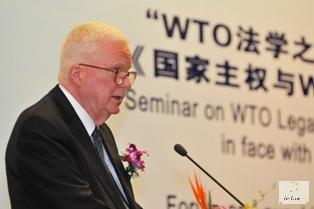 著名国际经济法学家约翰·杰克逊教授 Thank you very much for the entire introduction and all the welcome. We also enjoy very much coming to China. My first trip to China, I think now, is maybe almost 30 years ago and it is indeed to UIBE. So UIBE has been a regular focus for us. And I feel privileged to be involved as an honorary professor of this organization and this institution. And it’s been a very interesting time to watch what are happening. I do not come often because related to many other tasks I have. But every time I come, it just seems like there has been enormous changes in China. And the change of every trip is fascinating to see and really quite interesting. I have to say that many people in the world, including myself, believe there is an important relationship involved between China and the United States, and that the cooperation between those two very large economic entities could mean a great deal for the world, for the welfare, for the peace and so on. I think it is worthwhile thinking about those relationships. Now we know the two societies, particularly the economies, are somewhat different. I think that difference has been shifting over the last decade and is no longer as strong as it was some decades ago. But never the least, there are difference. For there to be an adequate and important cooperation, there has to be understanding of that difference. I’m most focusing on the economic and legal economic area. I don’t have much to say about many other areas, but we know how complex this relationship is between the United States and China as well as of course many other parts of the world. #p#分页标题#e# I want to say how pleased I am that my book has been translated. We have a very few copies, I understand, ready. This is one of those. I’m very pleased. And I want to thank very much for the translators, Professor Longyue Zhao on my left and Professor Jianming Sheng who is introducing the program today, and Professor Zhao Haikong and Liang Kai, who I understand are the principle translators. I knew when they undertook this; it would be a very difficult task. Indeed, after talking to them here and last day or two, I realize even more so how difficult it is to translate a book like this of mine. The book was really based partly on a series of lectures that I was asked to give five or six years ago at the Lauterpacht center in Cambridge University in England. And those lectures become the basis of the book. The book is much larger and much more extensive than those lectures. But never the least, those are the activities that encourage and force me to sit down and think about some very serious problems which of course I have been dealing with for decades earlier. But this is an opportunity. And this book is to put these together. So today I’m really going to focus on what is within this book, and also add to something that is perhaps a little more current, and how we see things operating in the world. For one thing, in many ways, this book is more timely today than one published in 2006, three years ago, because the world has moved into a crisis mode that is exceedingly troublesome. And many elements of that crisis relate to some problems I have discussed in the book and further discussions and working in my researches and studies. So I hope, and am very pleased that the book’s been translated into Chinese, because that means many more people in the world will have an easier access to some of these ideas. I have also to say it has been translated into many other languages, particularly Spanish. In think, between English, Spanish and Chinese, it covers a great deal of the world, making this book more accessible. So I’m very pleased about that. And I thank again the translators who toiled really very hard work going forward. Now I want to follow somewhat the structure of the book. After all, the book is at least partly the major purpose of this trip. Because of the translation and the encouragement that I was given by the translators and the publisher to come and present some elements of the book, I’m going to do that sort of following the structure of the book, but I will have additional things to say. Let me tell you how the structure looks. There are really seven parts, and some of those parts will be very short. I will try overall to avoid being too long, because I’m sure you all want here commentary and responses also. The first part will be introduction. The introduction, I tend to call a situation landscape. That is how we look the world today, a world of globalization. And I will get that in the introduction chapter. #p#分页标题#e# Secondly I turned to the technical aspects of international law generally. And part of that is of course international economic law. But I will address as I have in the book, some fundamentals of international law generally that apply across the board to all questions that involved in international relations today, not just the economic questions. So I will deal with that in the second chapter. Thirdly, I will deal with the chapter devoted to the concept of sovereignty. Many of you or all of you may be familiar with the concept of sovereignty. I’m one of those, one of many actually who are very skeptical of the traditional concept of sovereignty. And I will explain that in the context in that chapter. Fourthly and fifthly I turn to the WTO. In some ways you can see this book is divided into three parts. The first part is the problems, problems of the world, trying to identify in connection with international economic law and international law, which are the conceptual, philosophical and jurisprudential problems that are really hindering or making it difficult for us to develop institutions and cooperations that are absolutely essential for world peace and prosperity. And those three chapters that I have mentioned are the first part of the book looking at the problems. Then the second part of the book focuses on the WTO. And I think it is worthwhile to see the focus, because the WTO is today the prime example of an international law system that effectively works, not perfectly of course. But in very large major, the international law system put in place by the WTO works, and is the most powerful juridical or tribunal type institution of international law that exists today. And then the third part of the book looks at some implementation questions, and I will be very brief on those and draws some conclusions. So I will talk about the first three chapters. And then, as I said, the second part involves two chapters on the WTO. The first chapter on the WTO that is chapter four is the WTO Generally: what is WTO institution and so forth. But the fifth chapter is the key for us who are juridically inclined. That is we are lawyers or lawyers-to-be. Therefore we are interested in the legal system. And the fifth chapter of this book looks in detail at the legal system that has been set up by the WTO. So I will spend somewhat more time on that than some of the other subjects. And finally there will be two chapters. The sixth chapter that I have just mentioned something very quickly is about implementation ideas of other subjects other than international economic law as such. And then finally in chapter seven, I look at conclusions, perspectives, perceptions and reflections. So that is the outline for the seven parts. And I will try to signal those to help you follow the logic that I am pursuing. #p#分页标题#e# So the first part, the situation, what do we have? We have something called globalization. Quite often there are people saying the word “globalization” is flawed, because it means too much and is too ambiguous. And that is certainly partly true. Buy there is I think a sense we all have of what is meant by today’s world that is globalized. It is interdependence. It is a situation where various kinds of forces, particularly economic forces, move extremely rapidly from country to country. And in many cases, for governments to try to regulate independently, which is nation by nation, is impossible, because the governments do not have the means available to regulate in some of these areas where it takes international cooperation to achieve results, the results for the constituency of the nation. Tte results will help enhance the opportunity of families to enjoy their life over their life span and matters like that. Now why we have this globalization? What are the attributes? Some of the attributes are these interdependences I have mentioned; some of the attributes include the much higher participation of non-government organizations or private organizations-huge numbers of non-government participants. In some of the conferences, a number of thousands participants is non-governmental. Those are some of the attributes. What is under the skin? What is it that really created this situation which I think today is contrary to other previous globalization that I mentioned in the past, for instance the globalization in the 1900s and the earlier decade or the subsequent decades? That decade is deemed to be a globalizing period, but is quite different from the globalization we face today. What is it that makes some of the differences? It is the development, in the last four decades at least, of technology relating to transport and communications. These are the two fundament technological revolutions for the world of governance and economy that we see today. Why?
Take a look at transport. Transport today is remarkably cheaper, less expensive, and remarkably swifter than ever before. We see huge airplanes flying around the world with goods of the world. We see flowers from Central America, for instance, being sold around the world. We see different food staff being shipped in large airplanes all around the world, so they are available for broad choice for consumers everywhere. This is different and happens every day. We see these large airplanes landing for instance. I come for the area of Washington D.C. And we see the airplanes landing in that area unloading their foods, even that evening you could sometimes achieve the ability to enjoy that food from very far-distance country, for instance Australia which is far from the United States and Hawaii. It is really quite amazing to learn those developments. #p#分页标题#e# The other element I mentioned is communication. You are familiar with this. Communication is now instant. I would guess virtually everyone in this room uses E-mail and understands what means to have for instant communication to any part of the world almost at the tip of your finger. This is quite remarkable. It also means the money can move very fast. Huge sums of money are transmitted in minutes. Last November when the economic crisis became very serious, there were situations where certain activities in a country in Europe which would guarantee to provide bank guaranty for some of the depositary accounts in its banks, instantly it was imposed and announced there was to be a guaranty. It immediately put pressure on the countries like New Zealand, but also like the US. And the US had to respond with the similar guaranties within hours, because the movement of huge sums of money could be so fast, moving. This is a risk for the world. This is a risk of globalization. We have to have measures that are multilateral and international that can cope with those kinds of risks. If we’re going to be able to have satisfied lives for our constituency, so I think those two issues are very critical in the question of the economic crisis and in the question of globalization. One of the downsides of these is that these activities, which move very fast and also present a certain amount of vulnerability to fraud, for instance, and other crimes. So there are many problems. We have to be able to cope with them somehow. Now I want to turn to my second chapter. This is a bit technical. Those of you that have already studied international law and/or international economic law I think would be able to follow. And I want to get into this a little bit. What is international law? Philosophers and jurisprudence people including myself and others for centuries have studied this and tried to develop a theory of international law. I would say today that those theories are not very successful. Many of those theories are based on the concept of sovereignty that I will in the next chapter talk a little bit about. The theories regarding sovereignty are in many ways outdated, and really do not apply in today’s world. And if you look at the basis, the basic fundamental structure or the philosophical structure for international law, which in many ways stem from the idea of sovereignty, the idea of sovereignty is that each country, each nation state is sovereign, and is the top ruler, whether there is a congress or individual or whatever has complete monopoly power. Initially it owns nothing to any other power or rule structure in the world, unless the latter consents. It is a consent theory of international law that the international law only applies to the country that consents. It is troublesome in many ways, because we have so many different countries, so many different operations, we now see countries that has been flamboyantly criminal in the way they handle their own citizens by measures that are really too bad, hard even to describe. But even apart from that, it makes difficult to achieve certain cooperative mechanisms that the world needs. We are facing those mechanisms, we are facing a trouble period in our new current economic crisis, partly because of the deficiencies in international law and the way international is framed. So the concerns of the international law need some rethinking. It doesn’t mean we throw out the idea; it is concerned as important, but there need to be some rethinking. #p#分页标题#e# Let me pursue that a little bit more. You are all surely familiar with the general notion of international law, being divided into two types: customary international law and treaty. Customary international law relies on certain experiences of nations that developed into a pattern, a pattern not just out of practices and politeness, but a pattern that recognizes those countries that follow it recognize that they has an obligation to follow it. So that is one of the ideas. The problem with customary international law is enormous. It is very ambiguous, and we no one knows exactly how long it takes to change the customary international law. And there are someone saying the only way you change the customary international law is to violate it. There are many problems in customary international law. I can’t get into those now, and there is much literature particularly in the last decade about the defects of customary international law. For the most part, however, in the area of international economic law, that is not a struggle, because international economic law depends much more on treaties. It depends primarily on treaties, and very little on customary international law. So I will turn to treaties now. You could say of course treaties are consent based; treaties apply to those governments that accept the treaty. There have been some exceptions developing in international law, particularly in the United Nations Charter where there are propositions that the treaty measure will apply to a country even if it has not accepted it, particularly in the human rights area, for instance, and certain other measures-so called Jus Cogens. That is one technical side. Let’s look at the treaty question. Now we can think in terms of WTO treaty –the Uruguay Round Agreements as a prime example. The mere fact that you have a treaty dose not solves all the international law conceptual problems, because treaties are not all the things. We have to understand this is where the current concept and current philosophy breaks down. You have to understand that a different kind of treaties probably needs a different kind of attitude towards them in connection with interpretation and compliance. There is one type of treaty that I definitely think is a candidate for different treatment. And that is what I call the constitutional treaty. Using the word “constitutional” in some places is deemed bad. We all do not use “constitution” for anything international. I even heard a very prominent judge in England who once made a statement said that the only use of the word constitution is valid at the nation level. That’s nonsense, and that is not true. The word “constitution” is very broad, and it can mean lots of things. A neighborhood club has a constitution; a school has a constitution. It means a nation state constitution, but it can also mean that an international organization has a constitution like the UN or the WTO. #p#分页标题#e# What do we see in that context of constitution? We usually see a large number of members. In the WTO, we have 153members. And we often see a decision making process that depends on consensus or unanimity. This means in a case of the WTO, for instance, we have 153 veto powers. This poses some very significant problems as you can imagine. One of the things it often results in the context of constitution treaty is what we have called, in my writing and other people’s writings, treaty rigidity. It means quite often that once you have the treaty come into place after the initial negotiation and acceptation and adoption. It is virtually impossible to amend it. And therefore, as time moves on, the circumstances and developments, such as economic developments, change, the institution could go out of date. How do you remedy that? One of the ways to remedy that is to have an interpretive process or interpretation process. They can look at the treaty and say that we can’t flaunt the language, but we can look at the language and see that if language might enable us to do things in several different ways, some of which are necessary for the word correct continuing existence of the organization for its ability to carry out its mission, to which it has been assigned, for instance, in the area of trade for the WTO. So that gives you a certain different flavor of the dispute settlement system. In that system, of course, there is much attention given to something called Vienna Convention on the Law of Treaties, particularly article 31 and 32 that are devoted to interpretation. But those principles I will argue in a few minutes are not enough. That particular convention is useful as a studying frame, but it breaks down and is not enough for what we need in the future. Now let me turn to the third chapter and the question of sovereignty. The word “sovereignty” itself is plenty ambiguous, but it stems from a 1648 treaty, the Treaty of Westphalia. And that original idea was that the leader of any notion is sovereign and is independent, and can do anything to its citizens: chop of head, and chop of arms, and take away their property whatever he wants. This is the basic idea. No one thinks that is applied today. No one thinks the original Westphalia concepts of sovereignty are applicable in all respects today. But there is still a notion that there is important remaining activity that would be devoted only, or able to be used only via a nation state. There are certain attributes which could occur. Now sovereignty has been described by other scholars, particularly a very important author in the regard, as an organized hypostasis. Because in fact the word “sovereignty” is often used as a sort of mantelet, a sort of political lever to protect certain special interest and certain national interests that may not be appropriate for such protection. #p#分页标题#e# So what I have suggested in the chapter three of this book is that we look at sovereignty differently. We look at the question of sovereignty, not to throw it out. There are authors who say we are to throw out the whole idea of sovereignty. I’m not one of those. I think there is something important in the idea of sovereignty that we want to retain. We want to retain certain amount of decision making at local level, at nation state level. So the real issue of sovereignty is allocation of the power. The real issue of sovereignty then is to look at the policy structure relating to how it can best provide for human welfare everywhere, a bettering of their life, the sound economics and avoiding some of the risks like the crisis we now see, and so on. How can we do that? Can we do it relying solely on power in a nation state? The answer would be no, we can’t entirely do that. So, in short, you could say the question of allocation of power can be sort of understood by asking if a certain issue, whatever the issue may, might be, for instance competition policy, or antitrust policy, or intellectual property or what have you, is better taken up and decided in Geneva or in the WTO, or Washington D.C., or Sacramento California- the capital city of California, or even a particularly town or city in California, such as Berkeley California, or even at a local neighborhood. In another word there are a lot of places where you can allocate powers. And what you need to do is to study in depth why need you to place a power of a certain decision at a certain lever. And this means that certain subjects need not to be all devoted to one place or another. In other words, certain subjects might be partly important to decide at Geneva, other parts in Washington D.C. or Beijing, etc.. In other words, we have to slice up sovereignty. It is slice of sovereignty that really becomes important. So that illustrates in a somewhat simplistic way that I mentioned on sovereignty. Now I’m turning to the fourth chapter, the fourth topic here which is the WTO in general. The WTO is in my view a constitutional treaty, even though I have been personally criticized for using that term, but never the least, I will maintain what we have as something more on the order. But the constitution treaty is certainly not a bilateral treaty; it’s certainly not a small group treaty which can be renegotiated from time to time easily. It is huge. It has been negotiated by over a hundred nations, therefore, the text of that negotiation noticeably involves ambiguity and gaps. There is no way that you can put 120-150 nations into the negotiation, and come out the other end with something they can accept unless you have some ambiguities and gaps. So you have to have a mechanism to handle those gaps and ambiguities. And that is the dispute settlement system of the WTO. In all, it is genius, and I will come back to that. #p#分页标题#e# Now we see some basic policies for the WTO, we are all familiar with those. We want to increase welfare through the use of market system. The market system demands a regulatory structure. And I will come back to that. We want a system that can cope with risk and crisis; it can cope with keeping the peace. This is the original idea of GAAT incidentally stemming out of the Briton Woods agreement which did not cover trade but following up and adding the GATT to the picture of the IMF and the World Bank. The original idea was to keep the peace, that’s really all about in 1944 when the Briton Woods system was set up. And that has been reasonably successful when you look at it, so we really have those leaders in 1944 to thank for designing these institutions. But they are coming out-of-date. A striking example of that out-of-date is the governing structure of the IMF and the World Bank that does not give adequate approach to China for example, which now has the strength, power, will and intelligence to take a much stronger leadership in those organizations. That is an illustration of institutional rigidity that needs to advance some ways to achieve other results. The history of GATT has been troubled. Its entire history is never a pure treaty. It is provisionally applied to the Portugal provisional application. So it is only when the WTO came into a fact through the Uruguay Round, the treaty was completed in 1995, that we have a true international organization for trade. And the WTO is the first in the world, and to take over from the GATT as we know. So the WTO in that regard has been remarkably successful. As a start it has troubles; there is a long list of troubles that I can give to you now, but I won’t because it takes too much time. We have some commissions, some of which I’ve participating in about what needs to be done to the WTO or other international institutional structures. And we need to continue that work, and we need to give considerably more attention in that regard. But the GATT or the WTO now, is quite successful that many countries are lining up to get in. And of course now, China has become a member, remarkably, and I must say it will be a very constructive member, and one that is learning every year how could be more constructive in the sense of handling disputes and other matters in the context of that organization. So there are many issues. But I want to turn to the dispute settlement process itself. And this is the fifth of my topics, and this is the fifth chapter in my book. What do we have here? We have what is now generally understood by scholars, others, and policy makers: the most powerful juridical institution of international law existing today. It is powerful because of the mandatory competence and mandatory jurisdiction. The governments have all agreed by treaty to solve the disputes relating to any aspects of the WTO treaties. It is powerful because there is a process of procedure, sometimes being rather overwhelming. But never the least, the number of details provide for a sound and fair process of interpretation through juridical means or through juridical system. It’s a court type system, but the negotiators did not like to use the word “court”, they even did not like to use the word “tribunal”. So I use the word “juridical” which is a broad one. So that’s what we have. We have a remarkable number of suing, a suing-launch system. We have recently in January 319 complaints in about 13 to 14 years of history of this organization. That is many times the annual complaint number, for instance, of the World Court. We have already 116 case reports-Appellate Body and Penal reports. And that is a large amount of jurisprudence-something like 40,000 pages of jurisprudence. And that jurisprudence has abundant details about how interpretation of treaties should go ahead and how should be done. So there is a body of experience here. They could be valuable as we move forward in the world. #p#分页标题#e# Think in terms of breakdown of the economic system today and what is happen to the world. Much of that breakdown is because of a failure of adequate regulation by nation states and international bodies, particularly by nation states. The United States’ regulation of financial transactions needs a complete rework. There is no doubt in my mind and that of many other people, you see constantly it’s said over and over again, you see it’s said by the new president of the United States himself, you see it’s said by some leaders of the United States in the economic field with decades of experiences and so forth: there needs to be a rethinking of the way these matters, such as baking, are regulated, and there has to be successful regulation. I’ll come back to that in minutes. So, these are some of the things that we have to worry about now. Let me work you through what I call five-step logic of the importance of juridical or dispute settlement system just to illustrate different dimensions here. The first proposition is that markets can be extremely beneficial. The market system has provided well untold in the last decades and since World War Ⅱ in many ways. So market has an enormous potential for good. But the second statement is often mentioned by Nobel Prize winners. The second statement is that market will not work unless there is an institutional structure to the markets, because, the market working along the so called invisible hand of Adam Smith breaks down because of market failure. And there are some well recognized areas of market failures, for example monopolies are market failure, well recognized by economists. Insymmetry of information is a market failure where two sides of the transaction have unequal access to the information because if only the both are informed, you will get the appropriate agreement between the parts. That is that they recognize the risks of what they are doing, and can throw them into agreement, so insymmetry of information is another example. The next is public goods of variety things. There are certain kinds of public goods such as education, high ways, courts and telecommunication system which are basically difficult to operate only by the private market system. They need a governmental structure. So the second proposition is that there must be an institutional structure for the market to work. The third proposition, therefore, is that the basic structure for markets is rules. It is not the only way to have a structure. You can have polite activity. But rules tend to be the core of the structure for markets. Rules are law. And that is usually the essential part of the market structure. The fourth proposition is that if the rules are necessary, for them to work they have to be effective, the rules have to applied, and they have to be complied with. If it is not, they are useless; you don’t have a market structure. #p#分页标题#e# The final proposition is that one institutional way to increase the compliance of the rule structure is to have a dispute settlement system, a juridical system. It is that process that we do have in the WTO. This is justified by the logic that I have just given you. Now let me give you another a little hypothetical to illustrate that. Suppose we have a person in England and he has great wealth, and he has several million pounds that he wants to invest. Now he can invest in the London market, and he can get what is probably a fairly simple and not too exciting return on his investment. But he thinks that “I would go elsewhere of the world and see if I can get a higher return, I’m willing to prepare investment funds to another country. And his advisors suggest Costa Riga for example, a tiny country in Latin America, in the middle of America. They suggest Costa Riga for various reasons for it would be a good place to invest. And they suggest that he arrange, build and finance a shoe factory in Costa Riga, and that should be profitable, and should get him a considerable higher rate of return than he would get in the London market. So it looks like that his advisors look at [something else] also. They say of course there is a problem that Costa Riga is a small country, in order for your plant to develop a shoe that can be sold successfully in the market; it has to be a plant that has efficiency that depends on a certain volume, depends on producing more shoes than you can sell in Costa Riga. So for your client to be successful, as an investment, you have to be able to sell in other countries in Latin America, and particularly to the big country to the north, the United States. Now, assume no treaties, that investment is subject to the snap of the fingers of the government that says we block that trade. But there is a treaty system, a very elaborate treaty system, and that is the WTO system. And the WTO system then provides a large amount of predictability. And this is the key word. The word “predictability” is used in the treaty languages of the WTO in article 2 paragraph 3 of the Disputes Settlement Understanding. Predictability is the prime goal of the dispute settlement system. And that goal achieves for the investor a reduction in the risk, in other words, economist can call this a reduction in the risk premium. And that spread all over the world where there is ultimately an activity, which means a high rate of efficiency and welfare in the world in the line of reduction in the risk premium. So that is the way some of these principles that I mentioned actually operate to provide for the situation. Now in this process, it says often the diabolizing in the detail. And we look again continuing in my analysis of dispute settlement system. We see a serious jurisprudential issue arising in this rich jurisprudence of 40,000 pages, which is a rich jurisprudence and a very well constructed, even not perfectly, jurisprudence. It has lots of problems. The constant problem, which is one of the themes today, is the tension of the allocation of power between nation states and the international cooperative mechanism. And you see that play out in the jurisprudence. Almost every case in the jurisprudence of the WTO is a tension between the allocations of certain power to the nation state as compared to the international system. All sorts of procedure rule: where the burden of prove fall in a particular case; what is the evidence rule required; what kind of evidence should be presented. Time and time again, you can develop that in the theme of how to allocate power between the nation state and the international system. #p#分页标题#e# These are very important, but I can’t focus on all them. The one thing I do focus on for a minute close to the end is the question of treaty interpretation, because we have a situation where there is a lot of worry about treaty interpretation, and there is a lot of worry about an international juridical institution having too much power. That should be worried. We should constrain power at the international level as well as at the state nation level. We have to think that through in a sort of case-by-case way. But there has been too much reliance on the WTO and in the internationally interpretative mechanism outline in the Vienna Convention on the Law of Treaties. Many of you, I’m sure, are familiar with that convention. It is an important convention. But that convention hasn’t been adopted by more than 60 members of the WTO. More than 60 members of the WTO are not the members of the Vienna Convention on the Law of Treaties. And those include important members, such as the Unites States, Brazil, France, Indonesia and other countries, very important countries. The Vienna Convention, as a treaty, does not apply as a treaty in the WTO. On the other hand, scholars say the Vienna Convention represents the customary law of interpretation of treaties. And that is OK. It’s a good starting point for analysis of treaty interpretation. But it should not just confine to approximately 20 principles of interpretation that you find in the Vienna Convention, because that excludes some important other principles. What are some of those principles? In the first place, the way preparatory work is handled in the Vienna Convention is inadequate, which means what we sometimes call legislature history or looking at the negotiating records for propositions. We need a better way to handle that and certain structural problems about that. We also need to be able occasionally to use what is called purpose interpretation or teleological interpretation which goes to look at what is the purpose of the organization. Insofar as there are some attitudes in the language, interpret that language to best fulfill the goals of continuality of the institution to carry out its mission. There is a real risk of allocating too much power to the international system that I have fully recognized. So we really have to do that cautiously. It is clear that has to be done in some cases because of treaty rigidity and otherwise. There is also a question of evolutionary interpretation. We saw that in the Shrimp-Turtle case for those who have a chance to dig into that case which in my view is the most important constitutional case in the jurisprudence of the WTO. And finally, and very important, we need a recognition that there is a precedence system operating in international law tribunals. That is a little more revolutionary in some people’s mind, because there’s been a tradition based on article 59 of the International Court of Justice Statute that there is no precedence system in international law tribunals. The language of article 59 is that ruling of the World Court is binding only on the disputants and only in that case. And that is not the way the world is working. In fact, the way the world is working is to have lots of precedence effects. But be careful, this is not the common law precedence idea. And many people are confused about that. Instead it is a system of precedence that has different levels of usages, different ways of going about it. And there is a whole ladder of precedence effects-very strong precedence and very weak precedence and so on. Maybe the strongest precedence effect is the common law concepts. But that doesn’t apply to most of the world and the international system. But when you look at what’s happening internationally for instance, the Court of Justice and the European Community, they clearly are using a precedence system and they say so, the judges say so. Look at the WTO, the WTO Appellate Body is constantly relies on prior cases of various sorts. And there is a steel safeguard case about four years ago, which China participated in against the US, and China won its point in that case. In that steel safeguard case, in the penal decision first, then there is an Appellate Body decision latter, the penal report was thousands of pages long. That thousands of pages had 5800 footnotes to prior cases in the jurisprudence of the WTO. So you can’t tell me that there is no precedence effect. And recently in the Appellate Body opinions, we have a strengthening of the idea of the precedence effects. #p#分页标题#e# My sixth comment is to recognize there are other areas where we can apply some of the principles, like competition policy, labor standards and environment. And the climate change questions today are having enormous implications for the WTO. And it is very difficult, because the WTO rules probably do not adequately handle the difficult policy concepts of climate change, concepts that are coming along the Capitan trade system for instance, or other trade systems. So I’ll skip off that. If you look at some of the books, we have more recent things going on that make some of those issues worthwhile. There is a new book about to be published by the Institute of International Economics in Washington D.C., the Peterson Institute that deals systematically with these issues. The bottom line is that there are many difficult and intricate issues we do not have an answer for, as to how the environment is going to be handled under the WTO. So let me come to my conclusion, perceptions and perspective as well. Really to sum up, I just want to mention a few points to particularly emphasize what I hope you come away with in this lecture. For example, the impact of globalization and how it is applying and creating difficulties but as well as potential opportunities, which depends on and has been influenced by the technology of communications and transport. Secondly, sovereignty. I just use a word to remind you of the need to look at that. Thirdly, the problems of conceptual framework, the changing fundamentals of international law. Fourthly, treaty interpretation and particularly a number different interpretive techniques, specially including precedence. Now, as we moving in trying to cope with the world economic problem, as we might see the need for regulatory matters to handle to be both internationally and nationally much better than it have been. It is worthwhile looking at the experience of the WTO. Maybe the WTO has a role to participate in some of that regulation. But even if it does not, there is jurisprudence and experiences in records of the WTO. That could help us hopefully to climb out the difficulties to some extent over time. So I leave that with you, because all of you will have much to do with these, perhaps all of these. This is your future. This is as I tell my students, “look, if you focus on the WTO law, you know there’re these gaps and ambiguities because it is inevitable with a large constitutional treaty. So you have had you a life time of work trying to fill those gaps and ambiguities, as well as to create new constitutions.” And I leave those thoughts with you. Thank you! |
|||||
|
|||||